A Film Night Built Around One Story Told Twice
Plan a film night with two adaptations of the same story, giving viewers an easy way to compare pacing, visual emphasis, and each version’s priorities.
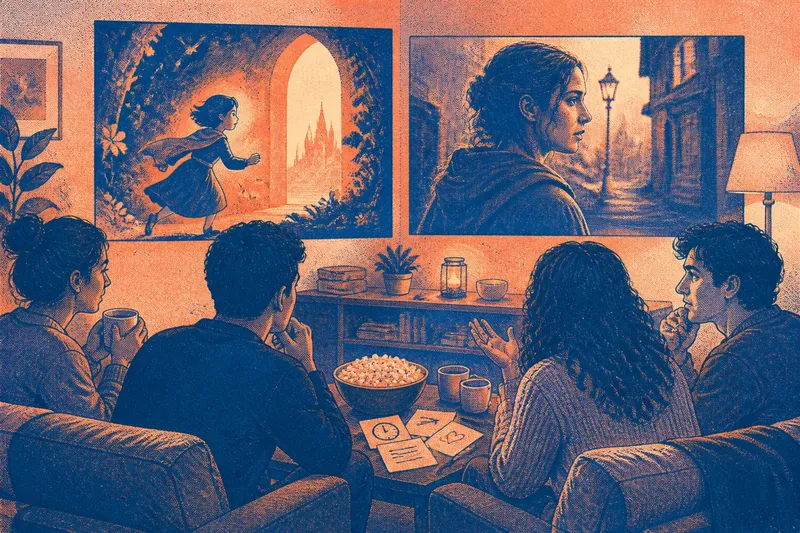
A film night with two adaptations of the same story can turn a familiar plot into a lively comparison of choices. The trick is to give the evening a light structure: choose versions with a clear point of contrast, leave room between them, and ask viewers to notice how pacing and visual emphasis reshape the tale.
Choose a pair with a useful difference
Start with a story that has traveled across screen cultures: a novel, play, folktale, comic, or public-domain narrative. Look for two adaptations that are genuinely distinct in form or approach, rather than two near-identical productions separated mainly by casting. One might compress events into a brisk feature, while another gives relationships more room in a miniseries or animated film.
Availability matters too. Check that both versions can be watched legally in your region and that the planned evening can accommodate their lengths. If one is a feature and the other a series, select a complete, self-contained installment only if it can be understood without leaving the story unfinished; otherwise, choose a different pairing.
For a clear comparison, the plot should be recognizable in both versions, but the treatment should invite questions. Does one adaptation linger on a character’s hesitation while the other moves quickly to the next event? Does one make a setting feel crowded and public, while the other frames it as private and enclosed? Those are differences viewers can see and discuss without needing film-school vocabulary.
Build the evening around attention, not homework
Imagine that Mara is hosting a relaxed gathering for four friends who know the story only vaguely. She chooses two adaptations of a well-known folktale: a concise animated feature and a slower live-action version. In the animated film, quick transitions and bold color make the protagonist’s choices feel playful; the live-action version spends more time on pauses and close views, giving the same choices a heavier emotional tone.
Mara checks runtimes and viewing access, then schedules the films on separate evenings rather than asking guests to sit through a double feature. She sends a short invitation explaining the premise and noting that nobody needs to read the source story first. That keeps the event welcoming while making the comparison clear.
For each screening, she offers one optional prompt: “When did the story feel as if it sped up or slowed down?” The question is broad enough for newcomers, but specific enough to draw attention to editing, scene length, and pauses. Mara avoids handing out a worksheet or assigning roles; the films should remain the main event.
Let the first screening establish the story
At the first gathering, Mara introduces the pair in a sentence: both tell the same central tale, but they handle its rhythm and imagery differently. She avoids explaining which version she prefers or what viewers are supposed to notice. That restraint gives everyone a chance to form an independent impression.
After the animated feature, she leaves a little quiet before conversation. Then she asks what image or moment stayed with people. One guest mentions the repeated bright doorway; another remembers how quickly the protagonist changes direction. Their answers already point toward visual emphasis and pacing, without requiring anyone to identify a formal technique.
The group makes a few notes on a shared card, not a complete scene-by-scene record. They write down the moments they remember and whether those moments felt hurried, suspended, funny, tense, or tender. The notes are reminders for the next screening, not evidence to prove that one adaptation is superior.
Give the second version room to change the mood
At the next gathering, Mara introduces the live-action adaptation without recapping every plot turn. Guests recognize the major events, but the film’s longer pauses and close framing alter their weight. A conversation that passed quickly in the animated version now feels like a turning point because the camera stays with a face after the words stop.
Afterward, the group compares moments rather than issuing a verdict. They notice that one version makes the journey feel like a chain of quick decisions, while the other draws attention to waiting and uncertainty. They also discuss how color, distance, and the amount of activity in the frame shape their sense of the protagonist’s world.
Say one guest remembers the animated film as the more cheerful version and another recalls the live-action film as more intimate. Instead of settling the disagreement, Mara asks which scenes produced those impressions. The group points to the animated film’s saturated backgrounds and brisk transitions, then to the live-action film’s quiet close-ups. Their differing responses become a useful part of the evening: emphasis can guide attention without dictating a single reaction.
Keep the comparison concrete
When discussion drifts toward “Which one is better?”, bring it back to a choice each film makes. A useful comparison might be how long each version stays with a decision, which character receives the clearest point of view, or what the camera shows while another character speaks. These questions connect an overall impression to something visible or audible.
It can also help to distinguish a changed plot detail from a changed emphasis. If one version removes a side character, ask what space that creates. If another moves a revelation earlier, notice how the new timing affects suspense. The aim is not to rank adaptations by fidelity; it is to see how altering the material changes the experience of the story.
Keep the source material in view without making it the standard everyone must know. A brief plot description or a short passage can clarify what the filmmakers were adapting, but a full reading assignment can turn a casual gathering into a seminar. Mara’s friends had enough context from the films themselves, so she saves the source comparison for a future occasion only if the group asks for it.
Small choices make the gathering feel relaxed
For two screenings, consider separate dates, or make the second viewing optional. A break between films gives viewers time to forget some details and notice fresh ones; it also respects guests who would rather watch one adaptation than commit to a long session. If the pair is short enough for one evening, offer a substantial pause with food and conversation rather than playing the films back to back.
Set up subtitles and sound before guests arrive, and make the room comfortable for sustained viewing. For a group with mixed familiarity, keep the introduction brief and avoid spoilers for either version. If the films use different languages, let the subtitles do their work and do not assume that every viewer will read at the same pace.
Food can suit the mood without pretending to represent a culture or place the film depicts. Mara serves simple snacks that are easy to eat between scenes and labels anything that contains common allergens. The point is comfort, not a themed menu that distracts from the films or reduces a setting to decorative cues.
What should viewers compare between adaptations?
How can viewers notice pacing without technical terms?
Ask where the story seemed to rush, pause, or dwell. Viewers can describe a long silence, a quick sequence of events, or a scene that felt unexpectedly brief without naming editing techniques.
What does visual emphasis mean in a film?
It is the way a film directs attention through framing, color, lighting, movement, and what it leaves in or out of the image. A repeated object or a close view of a face may make a detail feel more important than it did in another version.
Should the group watch the adaptations on the same night?
Only if the films are short enough and guests want a longer event. Separate screenings often make the comparison easier because viewers can enjoy each film on its own and return later to the moments that stayed with them.
Does one adaptation need to be more faithful to the source?
No single measure of fidelity makes a useful discussion by itself. Ask instead what each version keeps, changes, or emphasizes, and how those decisions affect the story’s pace and mood.
End with a question, not a winner
Mara closes the second gathering by asking which moment each guest would carry into a third version of the story. Their answers range from the animated film’s bright doorway to the live-action film’s lingering silence. The question draws out what each adaptation contributed, rather than forcing the group to choose a champion.
That is the lasting benefit of a film night with two adaptations of the same story: viewers leave with sharper eyes for the decisions that shape a narrative. Keep the invitation modest, choose a pair with visible differences, and let people respond in their own words. The best final note may be a detail someone wants to watch again.